
 By
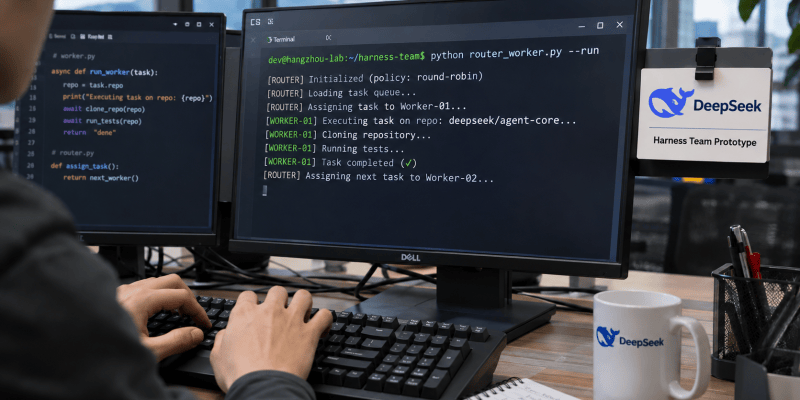
HANGZHOU, China — Chinese artificial intelligence company DeepSeek has published an open-source research prototype designed to coordinate multiple AI coding agents through a persistent workflow system. The project, released on October 31, 2026, by DeepSeek’s Harness team, introduces an experimental architecture that can monitor authorized software repositories, organize development tasks, and delegate work to separate execution sessions. The development reflects growing interest in AI systems capable of managing ongoing software engineering activities rather than responding only to individual prompts.
Prototype Introduces Router-and-Worker Architecture
The research project uses a router-and-worker structure to coordinate AI development tasks. A central routing component monitors incoming work and organizes it into assignments, while separate execution sessions handle individual activities. This design is intended to reduce the manual coordination required when multiple coding agents operate on the same development project.
The prototype can listen for activity in an authorized GitHub repository and may connect to developer communication channels. Based on the configured workflow, it can create tasks and return proposed results, including pull requests for review. The system is designed to operate within an environment where its permissions and available tools have been defined in advance.
DeepSeek Emphasizes Experimental Status
The company has described the public repository as a research prototype rather than a production-ready commercial product. It is distributed under an MIT license, allowing developers to inspect and experiment with the available code under the license terms. DeepSeek has also indicated that the public implementation differs from its internal systems.
These qualifications are important because a working research demonstration does not establish that a system is ready for deployment in sensitive enterprise environments. Organizations considering similar architectures must evaluate reliability, security, and the potential consequences of automated actions.
Persistent Agents Could Change Development Workflows
Conventional coding assistants often operate within individual user sessions. A persistent system can instead monitor ongoing activity and respond when new work becomes available. This approach could help engineering teams coordinate repetitive tasks, maintenance requests, and changes that require several stages of development.
However, persistent access introduces additional responsibilities. Agents may need permission to read source code, create branches, submit changes, or interact with development tools. These privileges should be carefully controlled to prevent unauthorized modifications or exposure of confidential information.
Human Review Remains Important
AI-generated code can contain mistakes, security weaknesses, or changes that do not match the intended requirements. Systems that coordinate multiple agents may also encounter conflicts when different tasks affect related files or services. Testing, code review, and clear approval procedures remain important safeguards.
The prototype highlights a potential direction for software engineering automation, but its practical performance will require further evaluation. The open-source release gives developers an opportunity to examine the architecture and experiment with agent coordination under controlled conditions.
Research Points Toward More Autonomous Software Systems
DeepSeek’s project reflects a broader shift from single-purpose AI assistants toward systems that can coordinate multiple activities over time. As the technology develops, enterprises will need to balance productivity gains with accountability, security, and operational control.
The release is significant as an experimental contribution to AI-assisted development rather than a confirmed enterprise product launch. Its longer-term influence will depend on community adoption, technical improvements, and whether similar architectures can demonstrate reliable performance in real software projects.















Comments