
 By
By 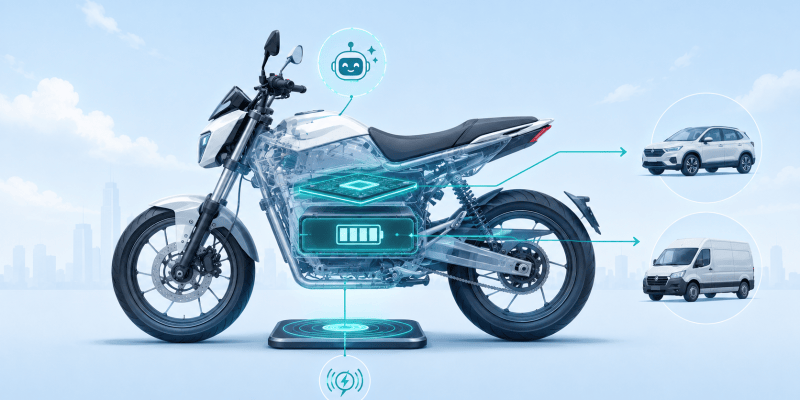
Most electric-vehicle startups pick a lane: build a great bike, or build a great component. Magron, a small Bengaluru company founded in 2022, is trying to do both at once. It is developing three electric motorcycles, but it describes itself less as a bike maker than as a technology company that happens to build bikes, with plans to license the pieces underneath, wireless charging, an AI riding assistant, an in-house operating system, to the wider EV industry.
The motorcycles come first. Magron is building a range across price points: a flagship, hand-built H35 around Rs 3 to 3.5 lakh, a mainstream C20 at Rs 2 to 2.5 lakh, and a stripped-down C10 below Rs 2 lakh, with the cheaper two due around mid-2027. That spread reflects a lesson the company learned early. It started at the premium end, even building a forged carbon-fibre prototype in 85 days, before concluding that India’s market is not yet ready for two-wheelers much above Rs 2.5 to 3 lakh. Founder Abiram Menon, an early engineer at Bounce and a former EV lead at Yulu, sums up the pivot plainly: the product has to be sensible enough to sell on its own.
The real bet is the tech stack
What sets Magron apart from rivals like Ultraviolette is that it treats a motorcycle as a bundle of technologies, each of which could be a business. The company says it has mapped more than 200 potential areas to develop and worked on over 50. The furthest along is a patented wireless charging system: park over a pad and the bike charges itself, no cable, with a self-aligning mechanism and automatic safety cutoffs. Magron wants to push it from modest speeds toward a far higher 120kW eventually, and to sell it not just for its own bikes but for other two-wheelers, cars, and commercial vehicles.
Then there is Miva, an AI assistant built for the road since 2023. Rather than a generic chatbot, Magron pitches it as an “emotional AI” that reads riding patterns, spots drowsiness or unsafe riding, and talks to riders in local languages and slang, with safeguards to stay quiet in dangerous moments. Like the charging tech, Magron is already discussing sharing it with other manufacturers.
Ambition, meet the balance sheet
Here is where a reality check belongs. This is a very early, very small company. It has raised only around $1 million so far and is seeking about $5 million more, with a first pilot of roughly 100 vehicles still ahead of it. That is a slim budget for building three motorcycles, a 120kW wireless-charging system, and an emotional AI, and then licensing all of it across the vehicle world. The vision is broad; the resources are not, and focus will be the constant test.
The market is unforgiving, too. Electric motorcycles remain a sliver of India’s two-wheeler sales, and Magron is stepping into a ring that already holds Ultraviolette, Matter, Ather, and Ola, with petrol bikes still the default and global giants circling. Grand claims about wireless charging and emotional AI will have to survive contact with production.
So is Magron building the future of the electric motorcycle, or biting off far more than a seed-stage team can chew? In truth, both are plausible. The team is experienced, the multi-revenue-stream thinking is clever, and the humility to improve rather than reinvent is refreshing. Whether $5 million can turn that into shipping products, and shippable technology others will buy, is the question the next two years will answer.












Comments