
 By
By 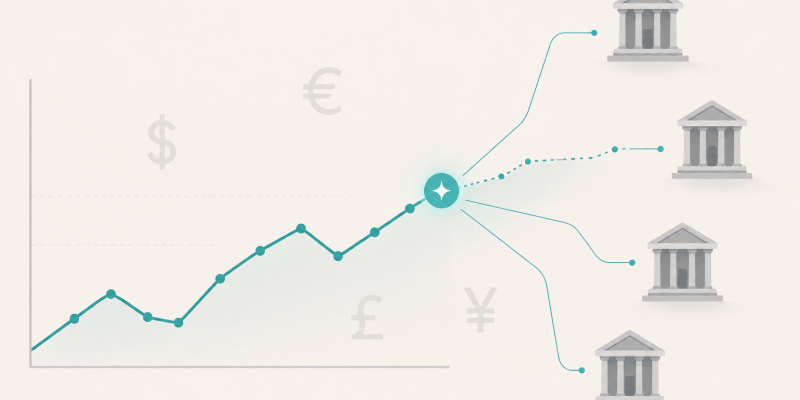
It is not often that Barclays, Citi, Deutsche Bank, and Standard Chartered all agree to plug the same outside model into their trading systems. That is what has happened with Falcon, a forecasting AI built not by a bank but by Ant International, the Singapore-based payments arm linked to Alipay. On Thursday the company launched version 2.0 of the model and named those four banks as having wired it into their own foreign-exchange platforms.
The job Falcon does sounds dry but matters enormously to anyone moving money across borders. It is a time-series model, meaning it predicts numbers that change constantly, things like cash flow, transaction volumes, and currency exposure. Get those forecasts right and a company can hedge its currency risk with precision. Get them wrong and it either over-hedges, wasting money, or under-hedges and gets caught out when rates swing.
Small model, big claim
Ant’s pitch is that a focused model beats a general-purpose one at this specific task. FalconTST 2.0, a transformer with close to two billion parameters, posted a Mean Absolute Scaled Error of 0.666 on a public leaderboard for time-series models, which Ant says puts it at the top, with forecast accuracy above 93%. The company also claims sharper predictions can cut FX hedging and allocation costs by more than 60%.
Those are eye-catching numbers, and they deserve a caveat the company is upfront about: the benchmark results come from Ant’s own testing, not an independent referee. The figure that carries more weight is a real one. In an earlier live deployment with Citi, a major Asian airline trimmed its FX hedging costs by around 30% on ticket sales. Half the headline claim, but measured in the wild rather than the lab.
A supplier and a customer at once
What makes this arrangement unusual is the relationship. Ant is not just selling banks a tool; it is also one of their treasury customers, and the model was first hardened inside Ant’s own operations, where it now handles the majority of the firm’s currency conversions. Each bank has folded Falcon into its existing kit rather than replacing it: Barclays into BARX NetFX, Citi alongside its Fixed FX Rates product, Standard Chartered into its SCALE engine under Singapore’s MAS-backed PathFin.ai program, and Deutsche Bank across its FX operations. Reuters reported the partner roster runs to six banks, HSBC among them.
For the banks, embedding a fintech’s model is a bet that specialised AI will sharpen the prices they quote clients. For Ant, fresh off a US$1.2 billion funding round and having open-sourced an earlier Falcon version late last year, it is a way to turn an internal tool into an industry standard.
The bigger signal sits underneath the announcement. While much of finance waits for a general AI breakthrough, the quiet wins are coming from narrow models doing one unglamorous job well. So is the future of financial AI a single all-knowing system, or a stack of specialists like this one, each tuned to a problem most people never think about? On the evidence of Falcon, the boring specialists are the ones banks are paying for.











Comments