
 By
By 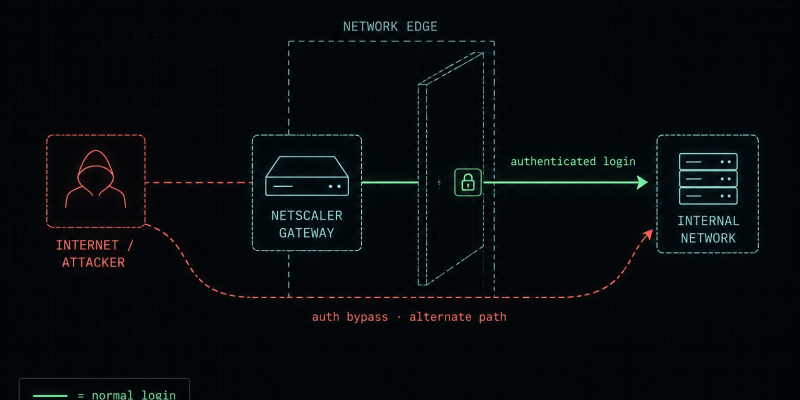
Citrix has patched a critical flaw in NetScaler, the appliance many organisations rely on as the guarded entrance between the open internet and their internal systems. Tracked as CVE-2026-19490 and rated 9.3 on the CVSS v4 scale, it is an authentication bypass, which is close to the worst thing you can find on a device whose whole purpose is to check who gets in. A remote attacker needs no credentials, no user interaction, and no foothold. As one consultant put it, this is the kind of bug that should make people move tonight.
No one has been caught exploiting it yet. That is cold comfort. NetScaler has a long, painful history of being mass-exploited soon after disclosure, from the CitrixBleed episodes onward, and CISA has flagged more than 20 Citrix bugs as known exploited over the years. Rapid7 expects attackers to move on this one quickly, and with roughly 24,000 NetScaler devices sitting exposed online, there is no shortage of targets.
Not every box is equally exposed
Here is the nuance the headline number hides. The flaw only affects appliances configured as a Gateway, covering SSL VPN, ICA Proxy, clientless VPN, and RDP Proxy, or as an AAA virtual server. On top of that, whether you are vulnerable depends on your version. On newer builds, exploitation requires a SAML authentication action to be configured. On older builds, any Gateway or AAA setup is enough, which leaves the least up-to-date deployments the most exposed. Citrix has published the configuration strings admins can grep for to check their own exposure, so this is one case where you can tell fairly quickly whether it applies to you.
The same update fixes a second, lesser issue, CVE-2026-19489, a memory-overflow bug rated 8.8 that can cause a denial of service, but only when a specific SIP feature is enabled. The authentication bypass is the one that matters. The flaws were reported responsibly by a penetration tester at JPMorgan Chase, and Citrix’s cloud-managed services are already patched, so the burden falls on organisations running their own appliances.
Patching is only step one
This is where teams often get burned. An authentication bypass can hand an attacker a valid session, and applying the update does not retroactively close a session that was already stolen. The CitrixBleed cleanups taught that lesson the hard way. So patching to the fixed builds, 14.1-73.32 or 13.1-63.21 and the matching FIPS releases, is necessary but not sufficient. Defenders should also kill active sessions, rotate credentials reachable from the appliance, and comb logs for signs that someone got in before the fix landed.
The honest read is that this is not yet an emergency, but it has every ingredient to become one fast: a pre-authentication bypass, an internet-facing target, and a vendor whose products attackers watch closely. So why treat a bug with no known exploitation as urgent? Because with Citrix edge appliances, the gap between disclosure and mass scanning tends to be measured in days, not months. The organisations that come through this cleanly will be the ones that patched before they had a reason to.














Comments