
 By
By 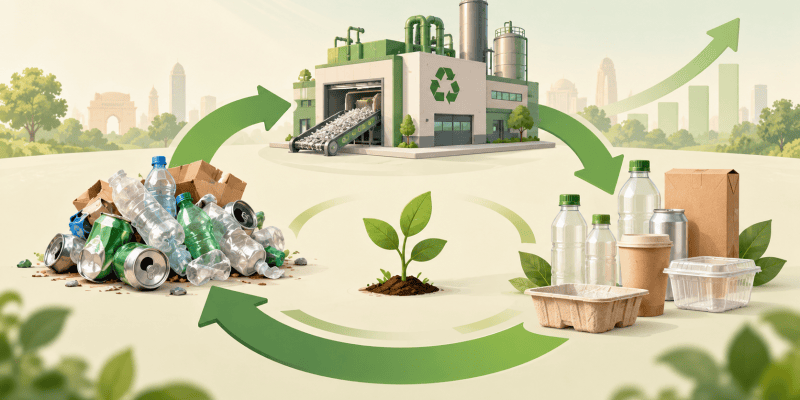
Not every funding story is a two-year-old startup chasing a billion-dollar valuation. Bonto Industries is a family-run recycled-packaging manufacturer that has been operating out of Bawana, on Delhi’s industrial edge, since 1995. This week it raised ₹4.5 crore, roughly half a million dollars, from the India-US venture firm Foxhog, which focuses on businesses outside the country’s big startup hubs. For a company that started as a family workshop turning waste into industrial goods, taking institutional capital for the first time is a genuine turning point.
The money is unglamorous and practical: expand recycling operations, add manufacturing capacity, and open new units across North India, closer to both customers and the recyclable material it depends on. Over three decades, Bonto has grown from that single workshop into a supplier of recycled cans, PET and glass bottles, and custom packaging to FMCG, beverage, and packaging companies. Its founding principle, using entirely recycled input material, was a niche idea in 1995. It is now close to a mandate.
Why now is the moment for recyclers
That is what makes the timing shrewd rather than sentimental. India has been steadily tightening the screws on packaging waste, with extended-producer-responsibility rules and requirements for recycled content in plastic packaging pushing brands to source certified recycled material, and only a limited number of licensed recyclers able to supply it. Add the wave of FMCG sustainability pledges, and demand for exactly what Bonto makes is climbing. A business that spent years as the responsible option is suddenly sitting in a regulated growth market.
There is a neat generational angle, too. Bonto is now run by Rama Agarwal, granddaughter of the founder and the third generation to lead it. She came in with a master’s in business earned in London and stints at Parle Agro and on Infosys’s ESG team, bringing exactly the sustainable-supply-chain expertise the moment rewards. It is a tidy example of a legacy family manufacturer being professionalised by a new generation, rather than simply inherited.
The unglamorous challenges
None of which makes this an easy business. Recycled manufacturing runs on thin margins and is capital-intensive, dependent on a steady supply of quality feedstock and, increasingly, on meeting strict food-grade certification standards that separate compliant recyclers from the rest. Bonto is also not alone: larger, better-capitalised players are racing to build recycling capacity as the rules tighten, and scaling a Delhi operation into a multi-unit North India network is a real execution test, not a formality. A ₹4.5 crore round is a useful push, but a modest one against the cost of building new plants.
A fair note on the record: this is a freshly announced deal, and the specifics rest on the company’s own account rather than independent reporting. Foxhog is a real firm with a stated focus on smaller-city businesses, which fits Bonto’s profile, but the figures here are the company’s to prove out.
So is this a small deal or a telling one? A bit of both. Half a million dollars will not reshape Indian packaging. But a thirty-year-old family recycler attracting institutional money, at the exact moment regulation turns recycling from a virtue into a requirement, says something about where the sector is heading. Sometimes the interesting story is not the flashiest company, but the timing behind an ordinary one.














Comments