
 By
By 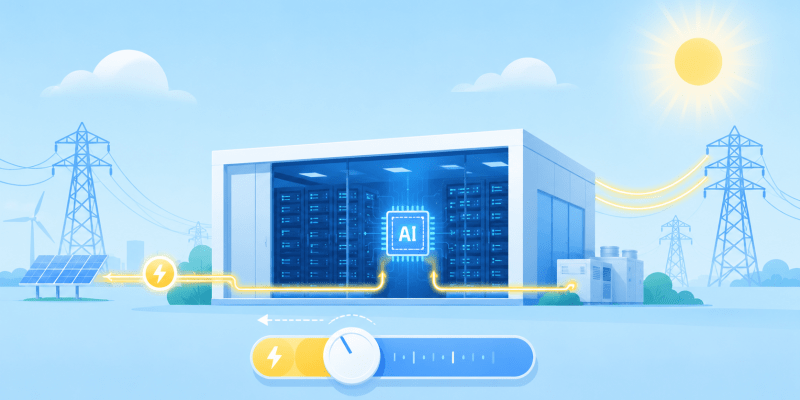
For a while the story of the AI boom was all about chips. Increasingly, it is about electricity. Emerald AI, a two-year-old US startup, has just raised $150 million in an oversubscribed Series A that values it at $1.05 billion, on a simple premise: the thing now holding AI back is not silicon or money, but the power to run it. As one of its investors put it, the binding constraint on AI is no longer chips or capital, it is power.
Emerald’s answer is not to build more power plants, which takes years, but to make data centres use the grid more cleverly. Its software, Emerald Conductor, lets a data centre dial its electricity draw up and down in response to grid conditions, easing off when the system is strained and keeping only its critical work running. In effect, it turns a data centre from a fixed, always-hungry load into a flexible one, which is exactly what lets utilities connect new AI sites without waiting a decade for new infrastructure. Emerald reckons this kind of flexibility could free up more than 100 gigawatts on the existing US grid.
Why the investor list is the real headline
Look at who wrote the cheques and the thesis becomes obvious. The round, co-led by Energize Capital and DCVC, pulled in around a dozen Fortune Global 500 names spanning the entire power-and-compute chain: Nvidia on the chip side, Samsung and Salesforce from tech, and a wall of energy players including Siemens, GE Vernova, RWE, JERA, and Aramco’s venture arm. When the companies making the chips and the companies keeping the lights on both back the same startup, they are agreeing on the problem. Founder Varun Sivaram, who has done senior stints in clean energy at Ørsted, India’s ReNew, and in US government, likes to frame it as turning data centres from grid villains into grid heroes.
The catch behind the unicorn
Now the sober part. A $1 billion valuation on a Series A, for a company barely two years old, is aggressive even in this frothy market, and it rests on five demonstrations and a single full commercial deployment in California rather than a deep book of paying customers. The technology has been shown to work; whether it scales into a business worth a billion dollars is still ahead of it.
The bigger question is behavioural, not technical. Emerald’s whole pitch hinges on AI operators being willing to throttle their power at the grid’s request. Every idle GPU is expensive, and companies racing to train and serve AI models are not naturally inclined to slow down. The promise of flexing only non-critical work, without touching the jobs that matter, is what has to hold up at scale, and only real deployments will prove it. It helps that Nvidia is a backer, though that also carries a whiff of the circular financing now dogging the whole sector: the chipmaker has every reason to unclog the grid so more of its chips can be plugged in.
This is not only an American headache. India is pouring more than $100 billion into AI infrastructure through the likes of Reliance and Adani, and it will hit the same wall. So is Emerald selling the fix for AI’s power crunch, or a promising idea the market has priced years ahead of itself? Probably a bit of both, and the constraint it is chasing is real enough that the answer matters well beyond one startup.














Comments