
 By
By 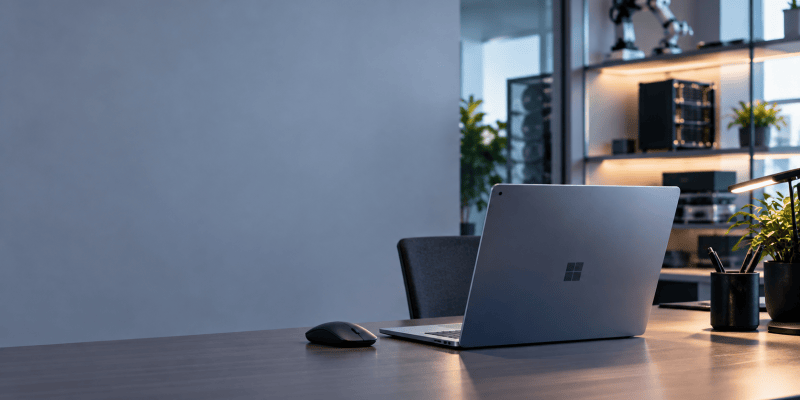
REDMOND, Washington, United States, Microsoft is expanding its push to bring artificial intelligence directly onto personal computers, introducing new AI models, hardware and security tools as it competes with Apple and other technology companies to shape the next generation of AI-powered devices.
At an event in San Francisco, Microsoft unveiled a new Surface Laptop Ultra powered by Nvidia’s RTX Spark chips and demonstrated AI models capable of operating locally on PCs without relying entirely on cloud data centers. The company is also integrating AI more deeply into Windows and its Copilot assistant.
The strategy represents a significant shift in how AI applications could operate on consumer and business devices. Instead of sending every task to remote cloud infrastructure, some workloads can be processed directly on a computer, potentially improving privacy, reducing latency and lowering cloud computing requirements.
Microsoft targets the next phase of PC computing
Microsoft’s new approach is centered on making Windows a platform where AI agents can perform increasingly complex tasks.
The company demonstrated AI models that can run locally on high-powered Windows machines, including Nvidia’s Nemotron model. Microsoft also said a version of Chinese AI company DeepSeek’s V4 model can operate on systems with at least 60 gigabytes of memory and perform strongly on certain coding and reasoning tasks.
Copilot is also being designed to divide workloads between local devices and Microsoft’s cloud. More demanding tasks can continue to use cloud computing, while applications where privacy, cost or responsiveness are more important can potentially run locally.
That hybrid approach could become increasingly important as AI usage expands and companies seek to control the rapidly increasing cost of cloud-based computing.
AI agents create new security challenges
The move toward autonomous AI agents also introduces new cybersecurity concerns.
Microsoft introduced Microsoft Execution Containers, a technology designed to restrict what AI agents can access and what actions they can perform on a computer. Anthropic, OpenAI and Nvidia are among the companies expected to use the technology.
The security layer is important because AI agents can potentially interact with files, applications and other system resources while completing tasks. Limiting those permissions could reduce the risk of an agent accessing sensitive information or performing unauthorized actions.
Microsoft’s approach reflects a broader technology trend in which AI capabilities and AI security are developing alongside each other.
High hardware costs remain a challenge
The biggest obstacle to Microsoft’s local AI strategy may be hardware pricing.
The new Surface Laptop Ultra starts at $2,599 and can reach $5,899 for higher-end configurations. Rising memory costs have contributed to higher prices across AI-capable computing hardware, potentially limiting adoption among consumers and smaller businesses.
For Microsoft, the opportunity is to turn the PC into a more capable AI platform while maintaining Windows’ large installed base. Success will depend on whether customers see enough value in local AI capabilities to justify the higher cost of the hardware.
The shift could ultimately reshape personal computing as AI moves from cloud-based assistants toward software that can operate directly on the devices people use every day.












Comments