
 By
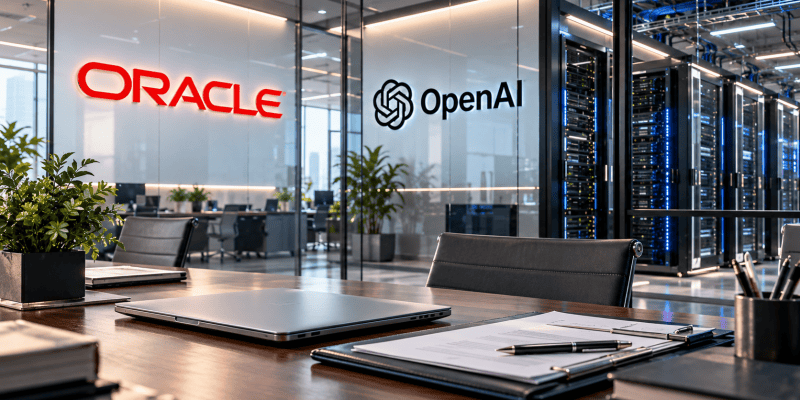
LAS VEGAS, United States — Oracle and OpenAI have announced an expanded collaboration to integrate advanced artificial intelligence capabilities into enterprise applications, cloud infrastructure, and business operations. The announcement, made during Oracle AI World on October 27, 2026, outlines plans to combine OpenAI models, ChatGPT, and Codex with Oracle’s enterprise software and technology infrastructure. The collaboration focuses on helping organizations use AI to complete business workflows, develop applications, analyze information, and strengthen cybersecurity while maintaining appropriate operational controls.
Oracle AI Workspace Connects Enterprise Applications With ChatGPT
A central component of the collaboration is Oracle AI Workspace, which brings OpenAI models together with Oracle applications, enterprise data, and cloud services. The workspace is designed to provide employees with a unified environment for accessing information and completing approved business activities. Through integrations with ChatGPT, users will be able to interact with Oracle systems using natural-language instructions, potentially reducing the need to navigate multiple applications to complete routine tasks.
The platform is intended to connect services including Oracle Fusion Applications, Oracle NetSuite, Oracle AI Database, and Oracle Cloud Infrastructure. Employees could use AI assistance to retrieve relevant business information, investigate operational issues, or initiate workflows across connected enterprise systems. Oracle says the environment is being developed with governance, approval mechanisms, and access controls, which are important considerations when AI applications interact with sensitive corporate information.
Partnership Expands AI Capabilities Across Business Operations
The collaboration also includes tools intended to support software development and enterprise productivity. OpenAI’s Codex technology is designed to assist with programming and development tasks, and its integration with Oracle infrastructure could help development teams build, maintain, and improve business applications. The companies are also exploring ways to make AI capabilities more accessible within established enterprise workflows rather than requiring employees to rely on separate standalone tools.
Another important component involves AI agents capable of performing multistep activities across connected applications. Unlike traditional chatbots that primarily provide information, agent-based systems can potentially interact with software tools to complete authorized tasks. However, the effectiveness of these systems depends on reliability, permissions, integration quality, and the ability of organizations to supervise automated actions.
Oracle and OpenAI Target Enterprise Cybersecurity
Cybersecurity is another area covered by the expanded collaboration, with Oracle introducing Oracle AI Security Mesh, a managed service that uses OpenAI cyber models to support vulnerability identification and remediation. The service combines AI capabilities with security testing tools, validation processes, and operational safeguards intended to help organizations assess potential weaknesses in their technology environments.
The offering is designed to support security assessments across Oracle Cloud Infrastructure, other cloud environments, and on-premises systems. Customers will be able to define the authorized scope of testing, while Oracle manages safeguards intended to reduce the risk of disruption during assessments. The approach reflects growing interest in using AI for defensive cybersecurity activities, particularly identifying vulnerabilities and supporting security teams responsible for protecting complex enterprise infrastructure.
Enterprise AI Adoption Enters a More Integrated Phase
Businesses have increasingly experimented with AI tools for writing, coding, research, analytics, and customer support. The next challenge is integrating these capabilities into established enterprise systems without compromising security, compliance, or operational reliability. Oracle and OpenAI’s expanded partnership addresses this challenge by connecting advanced AI models with business applications, enterprise data, and cloud infrastructure.
For organizations, the potential benefits include reduced manual work, faster software development, improved access to operational information, and more efficient cybersecurity processes. However, successful deployment will depend on factors such as data governance, employee training, integration complexity, and the reliability of AI-generated actions. The announcement does not establish that every planned capability is immediately available to all customers, and further product availability details will determine how quickly businesses can adopt the new services.
The partnership demonstrates how enterprise technology providers are moving beyond standalone AI assistants toward integrated systems designed to support everyday business operations. As companies continue evaluating artificial intelligence, the ability to connect AI capabilities with existing software while maintaining appropriate controls is likely to remain an important consideration.














Comments