
 By
By 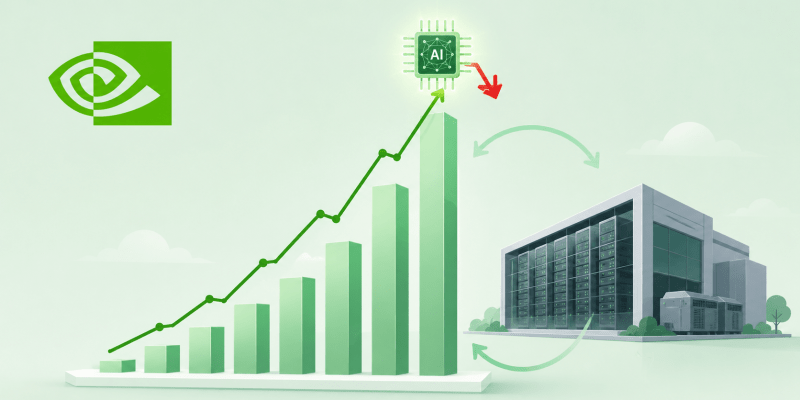
By almost any measure, Nvidia had another staggering quarter. Revenue hit $96.2 billion for the May-to-July period, more than double a year earlier and comfortably past the $92 billion Wall Street expected. Its data-centre business, the engine of the AI boom, brought in $89 billion on its own, up 117%. Profit climbed to nearly $60 billion. Then management guided to $108 billion for the current quarter and forecast roughly 70% growth for next fiscal year. And yet the stock finished the regular trading day down 1.6%. That gap, between spectacular results and a shrug from investors, is the real story.
The reason is that Nvidia’s growth was never really in doubt. What investors are now weighing is a harder question: whether the trillions of dollars pouring into AI will ever earn a return, and whether some of Nvidia’s demand is starting to feed on itself.
The circularity question
That second worry has a name now, circular financing. Nvidia has increasingly been helping to fund the very buildout that buys its chips. This month alone it assembled a $500 billion capital pool with Wall Street asset managers for data-centre projects and committed up to $105 billion to back an OpenAI data centre in Ohio. To bulls, that is a confident company greasing the wheels of its own market. To skeptics, it looks uncomfortably like Nvidia bankrolling its own customers, which can make demand appear stronger than organic buying alone would support.
Jensen Huang’s answer is a slogan he repeated all call: compute is revenue. His argument is that AI has crossed a line from expensive experiment to productive work, that the tokens these chips generate are now billable, profitable output, and that demand has broadened well beyond the single lab driving things a year ago to a whole field of AI startups, open models, and robotics. If that is right, the spending is justified by what the machines produce, not by hope.
Supply is the ceiling, not demand
One thing the quarter made clear is that Nvidia’s constraint is no longer finding buyers. It is making enough chips. Huang told analysts bluntly that the entire supply chain is stretched, that the company can confidently deliver 70% growth but that real demand is much higher, and that a price increase is coming. Supply commitments have swelled to a reported $279 billion, much of it memory for its next-generation systems. When your problem is that you cannot build fast enough, the boom is real, at least for now.
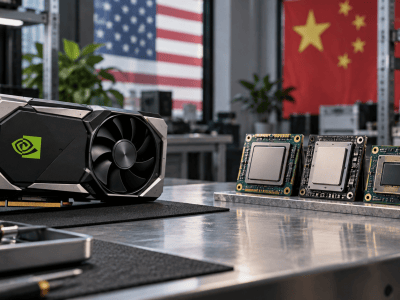
Still, the skepticism will not go quiet. Nvidia is worth around $5 trillion, more than the entire economy of Japan, and a company that size has almost no room to disappoint. Its gross margin is ticking slightly lower, its outlook assumes zero revenue from China, and the wider mood around AI has soured on questions of cost, energy, community pushback against data centres, and fears about jobs.
So has Nvidia proven the AI boom is built on solid ground, or just postponed the reckoning another quarter? The honest read is that its results answer the easy question and dodge the hard one. Nvidia can clearly sell every chip it makes. Whether its customers can turn all that compute into lasting profit, without Nvidia quietly helping to pay for it, is the question a blowout quarter cannot settle.














Comments