
 By
By 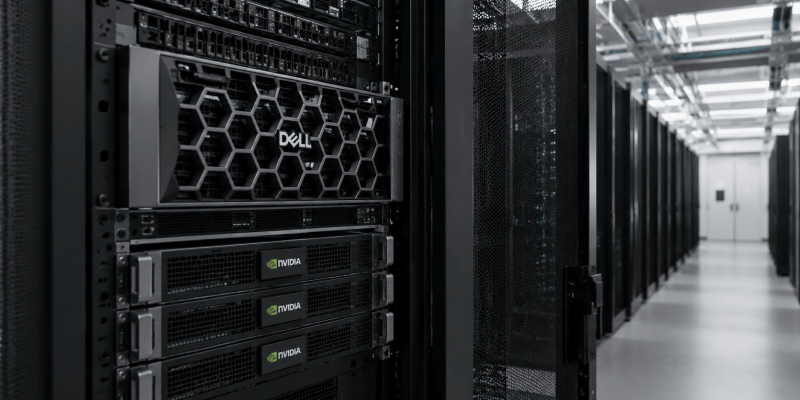
Dell just had the kind of quarter that makes the AI boom look unstoppable. Revenue hit a record $47 billion, up 58% from a year ago, adjusted profit more than tripled, and the company raised its full-year revenue forecast by a staggering $25 billion, the second time it has lifted guidance this year. Investors cheered, sending the stock up around 7% after hours, and Dell shares have now more than tripled in 2026. If you wanted proof that companies are still pouring money into AI infrastructure, here it is.
The engine is Dell’s AI-optimized servers, the Nvidia-powered machines that cloud providers like CoreWeave and Nscale stack into vast clusters to train and run AI models. That business doubled year on year, and Dell now sits on an AI-server backlog it pegs at roughly $95 billion, having booked more than $60 billion in new orders in a single quarter. Encouragingly, the demand is broad rather than narrow: Dell’s customer count has passed 6,500, spanning neoclouds, national governments, and ordinary enterprises, and even its PC business grew 20%, its fastest in five years.
The number that matters more than revenue
Here is the catch investors keep circling back to. Selling AI servers is a high-revenue, low-margin business. Dell mostly assembles machines around Nvidia’s chips, and Nvidia, not Dell, captures the bulk of the value in each box. Dell’s AI-server operating margins run in the mid-single digits, thin enough that the mix shift toward AI has already dragged its overall gross-margin rate down even as sales explode. In other words, Dell is moving breathtaking volumes of product while earning a modest slice of each sale.
That pressure is about to get worse before it gets better. A memory-chip shortage is pushing server DRAM prices up sharply this quarter, squeezing those already slim margins. Dell has been raising prices, including on PCs, to protect itself, but rising component costs are a real headwind. The company also cautions that AI-server shipments are “nonlinear,” lumpy and dependent on data-center construction and power, so that $95 billion backlog will not convert into revenue in a tidy line.
Real demand, real dependencies
None of this means the boom is fake. The breadth of Dell’s growth, from sovereigns to enterprises to a genuine PC recovery, suggests AI spending is maturing into a broad infrastructure-upgrade cycle rather than a narrow bubble. Traditional servers more than doubled as customers modernized for AI workloads. This is a real, cash-generating business firing on multiple cylinders.
But the dependencies are worth naming. Dell’s fortunes are tied tightly to Nvidia, whose chips power its flagship servers, and to a cluster of neocloud customers that are themselves heavily indebted and financially entangled with Nvidia, part of the web of circular AI financing now drawing scrutiny. A wobble anywhere in that chain would reach Dell fast.
So is Dell one of the AI era’s biggest winners, or a high-volume middleman running on thin margins and other people’s chips? For now it is both, and the tension is the whole story. The demand is undeniable and the revenue is real. The open question, the one the next few quarters will answer, is how much of that $95 billion backlog Dell can turn into actual profit once the memory bills come due. Selling the servers was never going to be the hard part.











Comments